
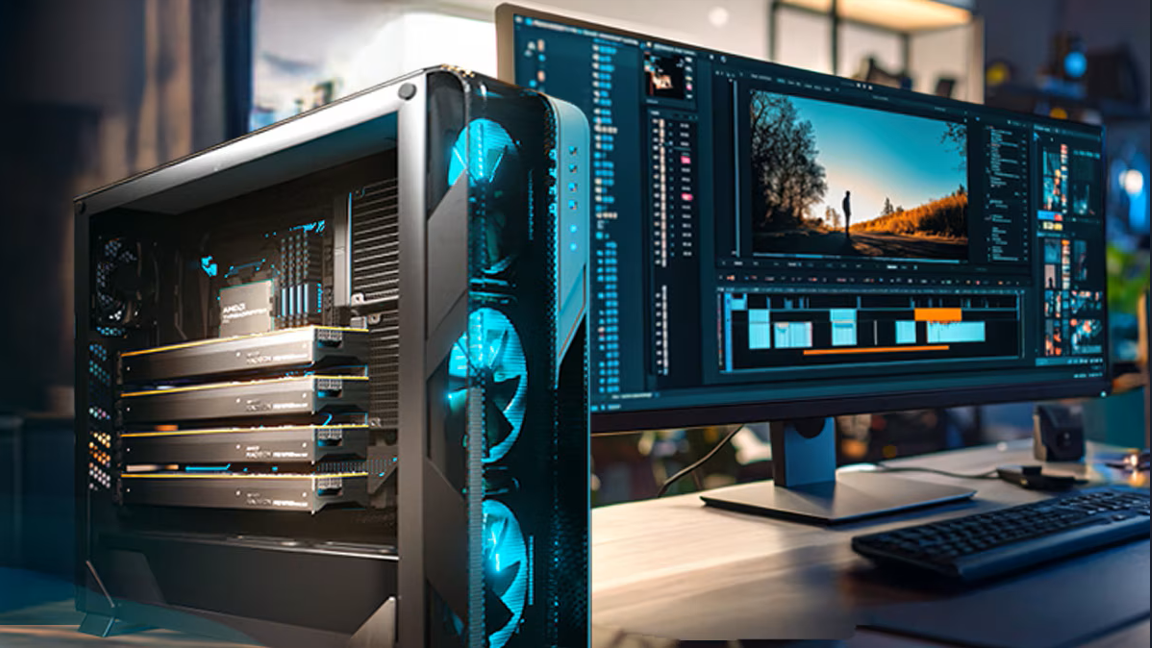
In the vast landscape of modern computing, few components hold as much transformative power as the Graphics Processing Unit, or GPU. Once considered a specialized chip solely for rendering visuals in games, the GPU has evolved into a versatile parallel processing engine, underpinning a myriad of applications far beyond mere graphical display. Understanding its true capabilities is key to appreciating the technological advancements we experience daily, from sophisticated scientific simulations to the seamless digital worlds we navigate.
At its heart, a GPU is designed for highly parallel operations. Unlike a Central Processing Unit (CPU), which excels at sequential task execution and complex decision-making, a GPU is engineered to perform thousands of simple calculations simultaneously. This fundamental architectural difference allows it to process massive datasets with incredible efficiency, making it uniquely suited for tasks that require repetitive computations across large arrays of data points. This parallel processing paradigm is the secret behind its remarkable performance.
Initially, this power was harnessed primarily for rendering graphics. Every pixel on your screen, every texture, every shadow in a 3D environment requires complex mathematical operations. A GPU handles these calculations with unparalleled speed, transforming raw data into the rich, dynamic visual experiences we've come to expect. Without its dedicated processing capabilities, even the simplest graphical interfaces would struggle, let alone the intricate realism of contemporary video games or professional visualization tools.
However, the utility of the GPU extends far beyond its original purpose. Researchers and developers quickly recognized that its parallel processing architecture was perfectly suited for other computationally intensive tasks. This realization sparked a revolution, enabling GPUs to accelerate workloads in fields like artificial intelligence, machine learning, data analytics, and scientific research. It became clear that the GPU was not just a graphics accelerator, but a powerful general-purpose computational device.
The continuous innovation in GPU design has solidified its status as an indispensable component in high-performance computing. From powering supercomputers to enabling breakthroughs in medical imaging and drug discovery, its impact is profound. The ability to process vast amounts of information rapidly has become a cornerstone of technological progress, driving efficiency and opening new frontiers in virtually every industry touched by digital transformation.
As technology continues to advance, the demand for ever-greater computational power shows no signs of abating. The GPU stands ready to meet this challenge, with ongoing developments pushing the boundaries of what's possible. Its flexible architecture ensures its relevance in an increasingly data-driven world, making it a critical asset for innovation and problem-solving across diverse sectors, including those served by IDs Process.
Key Applications and Considerations
-
High-Performance Gaming and Virtual Reality: GPUs deliver the visual fidelity and smooth frame rates essential for immersive gaming and realistic VR experiences. They handle complex scene rendering, physics, and lighting effects. While offering unparalleled immersion, these applications often demand significant power and can be costly to implement at the highest tiers.
-
Artificial Intelligence and Machine Learning: The parallel architecture of GPUs is ideal for training deep neural networks, significantly accelerating the iterative calculations required for model development. This enables faster advancements in areas like natural language processing and computer vision. A key benefit is rapid iteration, though specialized software knowledge and substantial cooling infrastructure are often necessary.
-
Scientific Computing and Data Visualization: GPUs are extensively used in fields requiring massive parallel computations, such as climate modeling, molecular dynamics, and financial simulations. They enable researchers to process large datasets and visualize complex phenomena with greater speed. The advantage lies in accelerated discovery, but optimizing code for GPU architectures can present a learning curve.
The Evolving Landscape of GPU Technology
The journey of the GPU from a fixed-function pipeline to a highly programmable, multi-purpose accelerator is a testament to relentless engineering. Early GPUs had dedicated circuits for specific rendering tasks, but modern architectures feature thousands of unified shader cores that can be programmed to perform a wide array of computations. This shift towards programmable parallelism has been fundamental, allowing GPUs to adapt to new challenges far beyond their initial graphical mandate.
A significant debate in the industry revolves around the balance between general-purpose GPUs (GPGPUs) and highly specialized accelerators, particularly for AI workloads. While GPGPUs offer remarkable flexibility, specialized chips designed for specific AI operations can sometimes offer superior energy efficiency and raw performance for those particular tasks. The choice often depends on the specific computational demands and the scale of deployment, with IDs Process often navigating these considerations for optimal solutions.
The explosion of data generated across all sectors, from IoT devices to cloud computing, has placed unprecedented demands on processing capabilities. GPUs have risen to this challenge, providing the necessary computational horsepower to analyze, interpret, and learn from these vast datasets. This symbiotic relationship between data growth and GPU advancement continues to drive innovation, pushing the boundaries of what can be achieved in real-time data processing.
Addressing the environmental impact of increasing computational power is a growing concern. Developers are constantly seeking ways to enhance the energy efficiency of GPUs, designing architectures that deliver more performance per watt. Innovations in manufacturing processes, power management techniques, and cooling solutions are crucial in ensuring that the incredible power of GPUs can be harnessed responsibly and sustainably for future technological growth.
Concluding Thoughts on GPU Significance
The Graphics Processing Unit has undeniably cemented its position as a cornerstone of modern technological infrastructure. Its unique capacity for parallel processing has not only revolutionized visual computing but has also become the driving force behind advancements in artificial intelligence, scientific discovery, and data-intensive applications across numerous industries. The GPU is more than just a component; it is an enabler of innovation.
As we look to the future, the continuous evolution of GPU technology promises even greater capabilities. From enhancing the realism of virtual environments to accelerating the pace of scientific breakthroughs, its role will only expand. Companies like IDs Process leverage this potent technology to deliver cutting-edge solutions, ensuring that the power of parallel processing is effectively applied to complex challenges.
Understanding what your graphics card truly does reveals a world of sophisticated engineering and immense computational potential. It's a testament to human ingenuity, constantly pushing the boundaries of what computers can achieve, shaping our digital experiences and driving progress in countless fields.
Comments (0)
Leave a comment